If an email from Microsoft recently told you that your Business Standard or Business Basic subscription "will increase soon," you're not alone. Microsoft raised prices on its two most popular small business plans this year, and the increase shows up the next time your subscription renews. For a lot of businesses, that's happening right about now.
It isn't a huge jump per person. Spread across a whole office for a year, it adds up, and a renewal is a good moment to look at what you're paying for.
What changed
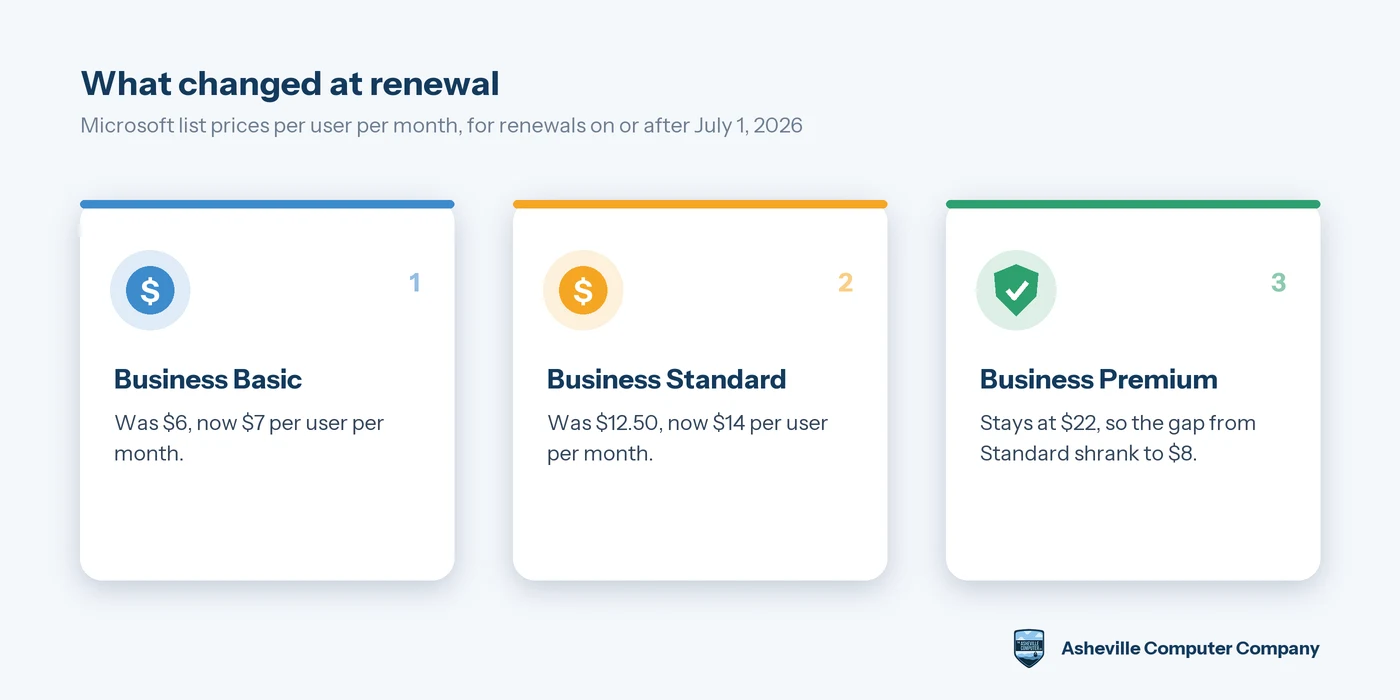
Microsoft's list prices per user per month, on an annual commitment:
- Business Basic went from $6 to $7.
- Business Standard went from $12.50 to $14.
- Business Premium stayed at $22.
The new prices apply to new subscriptions and to renewals on or after July 1, 2026. If your subscription renewed before July, you kept the old price until your next renewal, which is why some businesses are only hearing about this now.
Microsoft says the increase comes with added features, mostly around security and its Copilot Chat assistant. Whether those matter to you depends on how your team works, but the bill goes up either way.
What it adds up to
Say you have 15 people on Business Standard. An extra $1.50 per person per month comes to $270 a year. With 40 people it's $720. Not a budget breaker, but it's real money, and it's a good reason to make sure every license is earning its keep.
Four things to check before you renew
1. Licenses for people who left. This is the most common one. Someone leaves, their account gets blocked, and the license keeps billing for months or years. Look at your license list and match it against who actually works for you today.
Be careful how you clean these up, though. If you remove the license from a former employee's account, Microsoft deletes that mailbox after about 30 days. If anyone still needs that email, convert it to a shared mailbox first. Shared mailboxes generally don't need a paid license, and the mail stays where your team can reach it.
2. The right plan for each person. You don't have to put everyone on the same plan. Someone who only needs email, Teams and the web versions of Word and Excel may be fine on Business Basic. People who live in the desktop Office apps all day need Standard or Premium. Mixing plans is normal and can save a fair amount in a larger office.
3. Whether Premium makes more sense now. Business Premium didn't go up, so the gap between Standard and Premium shrank from $9.50 to $8 per person per month. Premium adds security and device management tools that many businesses end up paying for separately. If you already pay for some of those as add-ons, it's worth comparing the totals. If you don't need them, Standard is still fine.
4. Your renewal date and billing terms. Find out when each subscription renews and whether it's on an annual commitment or month to month. Month-to-month plans cost more than annual ones. An annual term locks in your price for the year, but you generally can't reduce the number of licenses until it renews, so do your cleanup before the renewal date, not after.
Where to look
Everything above lives in the Microsoft 365 admin center, under Billing. "Your products" shows each subscription, how many licenses you're paying for and how many are assigned, and the renewal date. If those two license numbers don't match, you're paying for seats nobody is using.
If you bought Microsoft 365 through a reseller, your domain registrar or your IT provider, the prices and the place to manage them may look a little different. The questions are the same, though: how many licenses, who has them, what plan, and when it renews.
Final thoughts
Price increases are annoying, and this one isn't optional. But renewal time is also the easiest moment to clean up licenses for people who left, put each person on the plan they actually need, and decide whether a different plan would cover what you're already paying for elsewhere. In plenty of offices that cleanup covers most of the increase.
Asheville Computer Company manages Microsoft 365 licensing, email and security for businesses across Asheville, Arden, Fletcher, Hendersonville and Western North Carolina. If you aren't sure what you're paying for, we're glad to take a look at your license list with you.
Further reading: Microsoft 365 prices rise on 1 July: what IT teams need to do before the deadline (UC Today).